Back in the olden days of writing (the 70's and 80's) authors were published by traditional New York publishing houses. If they wrote good stories and made lots of sales they rose to the top of the Best Seller lists. In genre writing (which is what historical romance is) those authors were "known". Stephen King is the king of horror fiction. Danielle Steele the queen of romance.
In this new publishing world of independent authors, we (most of us) do not hit any Best Seller lists for long. We rise to the top if we've worked hard and built a fan base, and are rewarded thus when we release a new book. But then it fades because we lose momentum. We don't have New York and the big money behind us pushing book tours and placement in the (now defunct) traditional bookstores.
What I've seen lately are authors who are using taglines to describe their work. One sentence that follows the author's name in blog post headers, on comments on blogs, in their Web presence.
"Romance through the mists of time..."
"Crime Fiction with a Kiss..."
You get the idea.
Awhile ago I decided to come up with one for my own writing. Not because I necessarily needed one, but because I received some comments from readers who don't understand what I'm writing.
In studying Austen's work, any of her work, she dives deep into the psychological make-up of women of that era and uses that against the mores and social customs of the time. Mr. Darcy is a snob. One can't deny it. He has no use for the lower classes. Until he meets Miss Elizabeth Bennet. Who in her own way is also a snob. She certainly has no use for Mr. Darcy.
In Emma, when she tries to match-make for Harriet. Austen shows the plight of women as she believes Harriet deserves more than she is worth by trying to fix her up with high-born men. In Northanger Abbey, we see the destruction of Isabella who is trying to make a play for Captain Tilney. And we can't forget Eleanor and Edward's tragic story. Need I say more?
In all of Austen's work, there is the stigma of a woman being less than, that we cannot aspire to be "better than we ought to be." There is a deep understanding of the human condition and the frailty of what it was to be a woman. Women had no rights, had no chance of becoming "more" than what their station observed. A parlour maid could not marry a duke.
In my romances, I try to take that same stigma and surround the plot with a modern day dilemma. In THE LADY'S FATE we have a much younger woman with an older man. In THE EARL'S ENGAGMENT we have a daughter taking care of a father with dementia. In THE DUKE'S DIVORCE we have a man who cannot reconcile himself to loving a woman who is so different than himself. LADY CADORET'S LONGING, a woman is grieving over the loss of her love through the vagaries of war.
In my next novel, THE CAPTAIN'S LADY, there is an element of danger. The husband is cruel to his wife. ( I do not write the violence, however I allude it is there. ) Spousal abuse is not something I wanted to write about, however, it seems the characters thought their story should be told. I hope I do it justice.
In real life, as well as back in 1811, life is not dropping a handkerchief and hoping some nice soldier will pick it up and you'll live happily ever after. Life is, for the most part, filled with the everyday conundrums that make us human. The happy and the not so much. War, cancer, Alzheimer's, spousal abuse, addiction -- these are some of the things that women must face in the modern era. How we tackle them and get through each day is what makes us or breaks us.
Same as in my stories. I write what I see and what I've experienced in my own personal life. As the saying goes -- "Write what you know." Well, my stories are what I know.
And that's why I write Timeless Romance....with Modern Day Dilemmas. Because at the end of the day, when we get through our dilemmas, we all need a happy ending.
Anne Gallagher (c) 2013

Sunday, November 3, 2013

Sunday, October 27, 2013
Historical Research -- Ships and Boats
 Good Morning. Well, now that the book signing is over, I've finally gotten back to Richard's story -- The Captain's Lady. And I haven't done an Historical Research post in a long time, so I figured I was due.
As we know, my main character, Captain Richard Gaines is suffering from Post Traumatic Stress. He resigned his commission soon after the Battle of Trafalgar and wanders the Thames at night searching for relief from his nightmares. He's fine, more or less, during the day, but he can't sleep.
Anyway, I was having a conversation (email) with a friend of mine, a very learned friend and as I was describing Richard's story (briefly) I used the words ship and boat synonymously. My friend corrected me "You do know that ships carry boats. Boats are small vessels."
 I had to grin. Yes, I do know that, but as I told him, I'm a writer and don't necessarily use the same word to describe the same thing, hence, ship/boat. I had done a boatload (excuse the pun) of research before, but leaving the book sit for so many years, once I got back into it, I realized I couldn't do what I wanted to do with the plot. (You tend to learn things when you do research and what I learned was that England and the US were going to be going to war when Richard's story was set. So I couldn't have Richard cruising the waters off North Carolina. Well, I suppose I could have but then the book would have been more historical than romantic.)
So, I started doing more research. About boats. Excuse me, about ships. Specifically, Ships of the Line. The Royal Navy had several different classes of Ships of the Line, which could carry different complements, had various guns, could perform different jobs.
A "gun" was a cannon, mounted inside the boat. (Different classes of guns -- some were bolted to the floor, others were on a "bungee" system of ropes -- and no they were not called bungees, but I can't remember what they were called. Suffice it to say, when the cannon fired, it recoiled and then bounced forward. The ropes were used to keep it from blowing out the back part of the ship.)
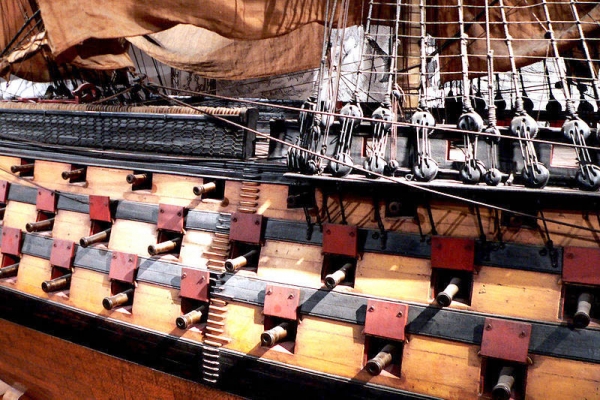 74 Guns were considered small ships. With 4 men to handle a gun, (more or less), powder monkeys (boys who ran down the line and gave each gun the powder for the cannon), and ball men ( on one website of nautical terms I found several euphemisms that have come down through the years about balls -- brass balls, busting balls, etc. ). So below decks during a battle, there were about 100 men slaving away trying to keep the cannons loaded and firing.
 Above decks, there were sailors (men who climbed the ratlines to unfurl the sails 3 men per sail, 3 sails per mast, 3 masts per ship), midshipmen (who took care of the decks 6 per side) carpenters, sailmakers, coopers, officers, petty officers, junior officers, mates, master mates and a whole array of other men who had lesser jobs. The life was hard, disgusting, dirty, the food horrible, the pay (if you weren't an officer) negligible. Which was why impressment was so prevalent during the Napoleonic wars.
 On a 74 gun, a typical complement was 220 men. (Notice the word complement has an e not an i. Two different words.) That's a lot of men on a boat. With the guns taking up most of the hold, you can just imagine what the sleeping quarters were like.
 And this is just a 74 gun Ship of Line. Can you even imagine what a 90 gun was like? 350 men? I can't fathom it.
Do I really need to do all this research for a romantic novel? The true answer is yes and no. I could have just skipped to the parts I really needed. Who was whom on the vessel and what they said or did. Do I have to know the names of the parts of the ship? Do I have to know the difference between a yeoman and a first mate or a petty officer? Not really. Will it add anything to the story if I mention the binnacle was wrapped in brass? Kind of but no, not especially.
Then why do I take so much time to do all this unnecessary research? Especially as I'm not even placing Richard on a Ship of the Line. As there will only be one very small battle between a cutlass and a trabocolu. Because I need to know what I'm talking about. If I said the bosun was manning a gun, I would be oh so very wrong and someone, somewhere would call me on it. Will I actually use most of the research I've done? Probably not. However, what I do use will be accurate and that is important. To me doing all this research helps set the "tone" of the novel. If I can't get the right tone, those scenes will be worthless.

 So ask me what my favorite part of the research will be?
Watching the Horatio Hornblower series with Ioan Gruffud and Master and Commander with Russell Crowe.
Swashbuckling, dashing, an oh-so-romantic Naval heroes. Now you know why I do my research.
Tell me -- Do you appreciate an author who does detailed research? Or would you rather just skip to the romantic parts?
Anne Gallagher (c) 2013
Sunday, October 20, 2013
The Book Signing
My first book signing was Friday night, for WHEN SUCH FRIENDS WERE MET. It was held at the Fall Festival at my daughter's school. While she ran around and played, I signed books with one of the "stars" of the book, Dianne. Mrs. Heaton, the other "star" had to go to D.C. for her son's engagement party.

Dianne and I had a great time. She knows EVERYBODY so we always had a full table. We sold quite a few books, and have promises from others to buy when we get back to school tomorrow.
I have more pictures, but I can't find my cable for the camera. If you check back by the end of the week, they should be up.
Have a great week!
Anne Gallagher (c) 2013

Dianne and I had a great time. She knows EVERYBODY so we always had a full table. We sold quite a few books, and have promises from others to buy when we get back to school tomorrow.
I have more pictures, but I can't find my cable for the camera. If you check back by the end of the week, they should be up.
Have a great week!
Anne Gallagher (c) 2013
Sunday, October 13, 2013
Would You Recognize An Author if you Saw One
 Good Morning. As you all know, I've been involved in a project for my daughter's school. WHEN SUCH FRIENDS WERE MET was released a few weeks ago, and the paperback is having its debut at the Fall Festival this weekend.
 However, most people at the school still don't know that I'm an author. They just think of me as...well, truthfully, I think I'm like everyone else -- just someone's mom.
As we've been promoting this book for the festival book signing, the woman who runs the after school care program came into the office one day and wanted to know what this "book" was about. I was standing there, but the secretary decided to fill her in. And then the secretary turned to me and said, "And here's our very own writer-in-residence."
Well, "Betty" looked at me and just about freaked out. "You wrote this?" "You're the writer everyone's been talking about?" Of course, I couldn't deny it. Although I had kind of wished I was wearing something other than my gardening clothes. Being my daughter's mother is one thing, being an author is another. I'd like to look like I'm smart enough to be a writer and not someone who's been attacked by an angry mud mob.
I chose a pen name a long time ago so that I would always be able to keep my writing life and my real life separate. Not that I ever expected to be famous, but in today's crazy world and social media insanity, I just wanted to keep some semblance of privacy. So far it's worked.
Until last week when Betty found out I was Anne Gallagher. I knew it was going to happen. I knew people would have that reaction "YOU'RE a WRITER. You wrote that." See, I don't look like a writer, not that I know what a writer is supposed to look like. (We always joke on the blogs that a writer is the one with a coffee cup in one hand, a red pen in the other, wearing yoga pants and a baggy shirt.)
Well, I don't have yoga pants, sweat pants, or pajama pants, but I do have gardening clothes. And firewood clothes, and housecleaning clothes. I have two pair of work-boots, a couple of pair of colorful sneakers, and lots and lots of shorts and stained t-shirts. (It seems I've been painting the rooms in my house every weekend for the last year and a half.)
What's also all too true, is that my closet is filled with clothes from ten and twenty years ago -- way before my daughter was born, when I was working. At least I had the good taste to buy "classic"... one can never go wrong with several little black dresses. However, all those clothes are way too "dressy" to wear to school.
I need "office casual" but I have no idea what that means. And if I did know what it means, I'm sure I'd need new shoes as well. (My shoes are outdated as well -- square toes, mary-janes, chunky heels). I guess I'm one of those women who always thinks those styles will come back around again and then I won't have to buy anything. However, we all know that doesn't happen all that often.
And this issue of what "a writer is supposed to look like" wouldn't have been on my mind at all except I saw a writer blog who showed pictures of a book signing and the author was wearing jeans and a black t-shirt. She looked like she was going to a rock concert instead of reading and signing books. Uh, I didn't want to look like that.
I think I'll blame this issue on my mother. When I was a kid, I always had to dress nice if we were going out in public. "You never know who we might run into. I don't need you embarrassing me by looking like a slob. And change your underwear-- you never know, you may get hit by a bus."
(Though this was back in the 70's so it shows just how far back this has been stuck in my memories.)
Anyway, I think for the fall festival I'm going to wear my black skirt and white blouse with my black boots. Yes, I might look like a waitress, but you can never go wrong in black and white. As for traipsing around school, I don't know. I'm going to have to find some basic skirts and tops.
Maybe I'll be lucky and the "Laura Ashley" look will come back around. That was big in the 80s and my closet is full of flowery dresses. And I would be able to wear my Mary-Jane's again.
Tell me -- What do you wear to go out in public? Do you have a "go-to" outfit that you wear for every occasion? Can someone explain what "office casual" is?
Anne Gallagher (c) 2013
Subscribe to:
Posts (Atom)