Showing posts with label research. Show all posts

Sunday, June 28, 2015

Historical Research -- Army and Navy England 1810

During the Reluctant Grooms Series, I had several characters in the Navy, as well as in the Army. I spent hundreds of hours doing research--most of it never used in any of my books. It's the necessary evil to writing good historical fiction. I know more about the Peninsular war fought in Spain and Portugal than I ever really intended.

I've put together a basic list of the different officers from the two branches of service in England in 1810


Navy                                                               Army

Admiral of the Fleet                                          Marshall/Field Marshall
Admiral                                                             General
   White
   Red
   Blue                                                                Brigadier General
Commodore (Ret. Capt.)                                   Brigadier
Captain /                                                             Colonel
Master and Commander                                    Lieutenant Colonel
Lieutenant Commander                                     Major/Commandant
Lieutenant                                                         Captain
Sub-Lieutenant                                                  Lieutenant
Ensign                                                               2nd Lieutenant
Midshipman                                                      Officer Cadet
***                                                                     ***
Warrant Officer                                                 Sergeant Major
Petty Officer  
Yeoman                                                             Sergeant
Leading Seaman                                                Corporal
Seaman                                                               Private


Lieutenant in His Majesty's Royal Navy
You'll notice there are three distinct Admiral's position for the Navy:

Admiral of the Fleet is the Commander in Chief. His command ships always fly the White Flag. They are traditionally first in the line of defense with the Fleet. They are the largest and most heavily powered Ship of the Line. They are called the Admiral of the White.

The Admiral of the Red is the second line of defense on the ocean.
The Admiral of the Blue is the third line.

The Captain of a vessel is not always the Master and Commander, but he should be. A Master and Commander knows everything there is to know about the ocean they travel on. Maps and stars are their best friends. He is the Master of the ship (as it were and knows how to do every job on it) and the Commander of his men. (Very important for dealing with personality disorder. Can you imagine living on a floating city for months at a time? I think not.)

It is striking to read accounts how the Royal British Navy dominated the oceans during that time
period. They had a superior battle plan and superior ships. Ports on every continent, (barring the Poles) and trade with the East.

Foot Soldier
The Army arrived in India (as early as 1682) to protect The East India Company against the sitting Rajahs. Toward the 1750's and into the early 1800's, the Army was an integral part in the trade from the East. A lot of people made a lot of money.

Officers in both the Navy and the Army, usually bought their way into a commission. Second and third sons of noble houses made up most of the officer positions. However, if you were considered a good leader, you would be promoted within the ranks.

Both the Navy and Army had certain "other" occupations that I learned. In no particular order, function, or ranking-- a basic list of gentlemen's jobs within the service.

Navy                                                  Army

Boatswain (Bo'sun)                                Hussar
Coxswain                                            
Yeoman of
  Powder Room                                      Foot Soldier (infantry)                
 Surgeon                                                 Home Guard
Master Gunner                                            Calvary
Master of the Sheets                                     Dragoons
Master of the Sails                                            Royals (King's Own
First Mate                                                           Queen's Own,
(all of the above)                                                 Prince's Own)
Second Mate
(all of the above)


I confess, I do know more about the Navy rather than the Army. In THE CAPTAIN'S COINCIDENCE I wanted Richard Gaines to be an authentic hero. I watched Russell Crowe in Master and Commander Far Side of the Universe a lot while I wrote that book. It's mind-blowing to realize over 400 men lived on boats like that for months at a time.

I took a virtual tour of the U.S.S. Constitution, to get some ideas on how big a Ship of the Line actually was. I also spent a lot of time emailing a sailing aficionado on the other side of the world. I researched gun powder, how to load a canon, different types of canon shot, how to sail. I do know the basics of sailing, however, these are huge vessels sailing in huge waters. It really is a whole other world entirely. I think the research was well worth it.

Doing research should never be boring. I love watching period films and are always eager to see new adaptations of old classics. I get a feel for the clothing, accents, and affectations of the characters especially if the film is a true historical drama. I've been known to take notes.

https://commons.wikimedia.org/wiki/File:
Peninsular_War_Map_
"Peninsular War Map 1808–14" 
by Derivative work: Marcus British Relief Map of Spain.
I think it's important for a writer to understand as much as they can about the period they're writing in, otherwise they look foolish. I like to be able to point at a few of my reviews that say I knew the Regency era. I'm glad they wrote that. I'm very proud of all the research that I do.

I've always loved maps and find them extremely important in every aspect of historical fiction. I don't think you can write historical without some kind of map. If only to give you a point of reference, and a working timeline. Your hero really can't come home from the Battle of Prussia unless you know it's already been fought.


Very soon, I'll begin another phase into the research I need for the Army. Henry Wade is going to be an interesting character.

For those of you who write -- Do you do a lot of research, do you wing-it, or are you somewhere in the middle?

For those of you who read -- Do you appreciate a writer who's done the research, or do you tend to skip over those parts of the book?

Anne Gallagher (c) 2015


Sunday, February 8, 2015

Historical Research -- Settings

Good Morning. I haven't done a research post in a long time. I thought I would today.

When I first began writing, they used to call where we set our stories "Settings". Now they call it "World Building".

Anyway, last night I was working on WHEN ALL HOPE IS LOST. Lady Olivia is on her way to Seaford, a little estate outside of Brighton. (If you haven't read THE SEDUCTION OF MR. SUMMERVILLE yet, I won't spoil it for you and tell you WHY she's going there.) Well, Olivia is on her way, and first of all, I needed to know how she got there. Naturally, by horse and carriage. But, the larger question was, which route did she take.

Google Maps showed me three. Yes, I Google mapped it. The route, as the crow flies is 55 miles from London to Brighton. I am presuming that the route she took was the road that has been in existence for at least 200 years. If not, oh well. I TRY to be as accurate as possible in my "world building". Sometimes it just doesn't work, so I fudge. It's fiction.

a pivotal scene in the book happens here
You may wonder why I bothered to Google the route at all if it's fiction. Because I needed to know how long it would take. 55 miles by horse and carriage = 2 days. Horses travel 25 miles per day. (Well, they can do more, however, we have Lady Olivia + 5 servants + luggage + a heavy coach. We don't want to kill the horses now do we?)


The other thing I needed to know was WHERE exactly my fictitious estate of Seaford was going to be. I chose a little out of the way town called Offham in Sussex about a mile from Lewes on the River Ouse. That is about 10 miles outside of Brighton. It looks like a farming community from what I could see on the satellite image from Google maps. The little white dots I saw were sheep. For all intents and purposes, it is just what I wanted. And I wanted it on a river because ... well, I can't tell you. You'll just have to read the book. (If you want to Google it yourself, go to Google maps, and in the search bar type in Old St. Peter's Church, or Ivors Lane, Offham, UK. You'll see exactly where the estate of Seaford is supposed to be.)

the pond
So, I knew WHERE it was going to be, now what did it look like? That my friends, is where I spent nearly three hours on Google Images sorting through pictures of manor houses and estates for sale in England. Nothing looked right. I didn't want it too big, nor too small. I wanted it a little run-down, but still serviceable. Olivia has to live there after all.

As a "visual" writer, (meaning I need to have a picture in my head of my characters and my settings which is why I spend so much time with Google Images) I generally can't write unless I can "see" who or what I'm writing about.

this is just amazingly pretty
Anyway, I found nothing in the "For Sale" categories. However, I found a picture from the NSG (National Scenic Gardens). From what I understand, they have walking tours of these  houses and gardens when in bloom -- and what a lovely idea. (We have those here in America, but on a much smaller scale.) I found a few pictures, which then led me to Coton Manor, Paxton House, and one other whose name escapes me.


For your viewing pleasure, here is my fictitious estate of Seaford. (Otherwise known as Coton Manor.)

Note the wisteria climbing up the front and the river walk
different view of the front gardens


Naturally, when Olivia first arrives, it does not look like this. But it will when she's done with it.

I think that when writers write, their imagination is one thing, but having a visual back-up helps. In my instance, the wisteria on the front of the house lends itself into my storyline that otherwise I would not have been able to use this picture. Kind of fortuitous for me.

World Building or Settings, it doesn't matter what you call it, only that you know where your story takes place. (Naturally, this doesn't work for all genres, but it helps.)

What do you think of Seaford? Wouldn't you love to go there? I know I would.

Anne Gallagher (c) 2015

Sunday, July 27, 2014

Historical Research -- Politics

Good Morning. As we all know, one cannot write a period novel without doing research. Throughout my series, I've needed to delve into the politics of the time.

First of all, let me say, I am an American. I have a hard enough time keeping track of my own country's political history. Second of all, I'm a genre writer, not an historian, so if I decide to use political aspects in my books, it had better be for a good reason.

I've found there are two trains of thought to using politics -- the first, as a decided focus of the main plot. And second, as an added layer to the general background of the setting.

For example:

In ROMANCING LADY RYDER, I focused on one particular point in the Napoleonic Wars -- the negotiations between Russia and England. In a nutshell, my main character the Earl of Greenleigh is a spy. He leads a double life -- in Society he is known as a lover of art. In reality, he works for the Foreign Office gaining secrets. We start out in France, but then because of Illora Ryder, we are enmeshed in the political dealings between Russia and England. (Russia's leader Czar Alexander finally realized Bonaparte was a maniac and even though he had made an agreement with him, he decided to hedge his bets and stay on the good side of England just in case.)

I used several key figures from Russian history as well as England and although 99% of it is not true, the 1% I did use, worked. Well, it worked for me anyway.


In THE LADY'S FATE, the Marquess of Haverlane and Duke of Cantin, are with Prince George as advisers to get him seated as the Prince Regent. I did not say specifically what they were advising George on, but it got them out of the house.

With each of my books, I have looked at certain aspects of British political history, but I have never done a comprehensive "lesson" as it were. Truthfully, there was so much going on, I can't wrap my head around it as a "whole", which is why I've tended to break it into smaller palpable pieces.

In LADY OLIVIA'S UNDOING, I dove into the East India Trading Company a
well as a few particular battles in Spain and Portugal. In THE CAPTAIN'S COINCIDENCE I used the alliance between France and America as a backdrop. Somewhat. (There's so much there I didn't want to get bogged down -- which I did, and then cut it all out.)

In using politics for background, I feel it is better to give a general overall feeling to the plot rather than a history lesson. Unless, as I said previously, you're writing a TRUE HISTORICAL novel. Which I'm not.

Tell me -- How do you feel about using historical information?

Anne Gallagher (c) 2014

Sunday, March 16, 2014

Historical Research -- Non-Pertinent Information

Good Morning. Now that THE CAPTAIN'S COINCIDENCE is published (yes, yesterday as a matter of fact, and is available everywhere) I took a look at the next story I'm going to write in the Reluctant Grooms series. LADY OLIVIA'S UNDOING.

Now, for those of you who have read my books, you know Lady Olivia plays an important factor in almost all of them. She's a busy body of the first water, a dragon, a harpy, but if she likes you, her friendship knows no bounds. She also thinks she's a matchmaker.

What you don't know about Lady Olivia will surprise you, which is why this post came about. In order to write Olivia's story, and the subsequent two remaining books in the series, I had to do a lot of "unnecessary" research. I say unnecessary, but it's not. It's more tedious than anything really.

Olivia carries a secret that I didn't even know she had until last year, which is also why it took me so long to develop the first two books (LADY'S MASQUERADE and now CAPTAIN'S COINCIDENCE). I wanted to make sure I planted the seeds of it early, so if you care to read the whole series in order, it won't come out of left field. I guess you might call it a "theme", but I never intended it that way.

So, here's some non-pertinent information I had to develop for Olivia that involved research.

* She's a Churchill. Yes, THAT Churchill. (She's Winston's relative).
* She was married at 20, to a man who was 62. (I developed family trees for both.)
* Her friends when Fuzzy (her husband Fitzhugh) was alive included, the King and Queen, George Grenville, Duke of Portland, Shelburne, Lord North (these men were all major players in Parliament during the American Revolution.)
* She's a staunch supporter of the Whigs (although Fuzzy was a Tory).
* She's having an affair with the butler Quiggins. Shocking I know. But she loves him. (And by the way, Quiggins is not actually a butler. I touch on that a little bit in LADY'S FATE. And in uncovering who HE really is, involved more research.)

And so you may wonder, why did I do all this non-pertinent information searching? Because I need to know it. I can't write a book that involves the history of England during the time of the Regency without it. Even though it's fiction, I still need it to be believable. And even though sometimes I fudge a little on the details**, I still need to make it coherent. I need to sound like I know what I'm talking about. And for the most part, I do.

I can't claim I know everything, because well, I'm a writer, not an historical researcher (although, I could probably get a job doing that), but I know more than most, and I could probably get through a round of Jeopardy and win the "Regency" category. lol

If you follow my blog posts, you know I kvetched about the research I had to do for COINCIDENCE. Ships, cannon fire, mapping, nautical references (I can insult someone fifteen ways to Sunday now and not swear once), traveling times, America and their part in the Napoleonic Wars (which incidentally was a lot more than they teach in school), and who was in charge of what department at Whitehall. I did the same thing with Greenleigh in ROMANCING LADY RYDER with the Russians.

Some of it showed up in the books, but for the most part, I didn't bog the story down with all the details. You would have been bored. (Maybe you are) But to me, those unnecessary bits of research that mean nothing to you, allow me to develop the stories and my characters more fully (at least in my mind) so I can give the readers a fuller broader scope of it all.

** As for fudging the details -- because what I write is FICTION, I have taken some information and distorted it to make it fit better in my book. In COINCIDENCE for instance, the Pirate Moody was a real pirate from North Carolina. However, he plied the waters off the coast of America in the early 1700's, not 1800's. Also, I refer to the artist Thomas Gainsborough. In my story, however, he is Thomas Gaines-Borough, so he can be related to Richard Gaines the hero in COINCIDENCE. (I'm sure I'll get letters about THAT.) In the DUKE's DIVORCE, I took the facts about divorce in the early 1800's and distorted them to fit the book. And we all know that Prince George could not create Letters Patent, however, he had a hand in them for William in MASQUERADE. I write FICTION.

Tell me -- How far do you go when researching? Do you get in, get what you need and get out? Or, do you follow the trails of tangents that you think might be important, or maybe interesting?

Anne Gallagher (c) 2014

Sunday, February 9, 2014

Historical Research -- Travel Time

In writing any kind of historical, I cannot stress the amount of research necessary to make it believable. No, some people don't really care when the Battle of Hastings occurred or who sat in Parliament on the day Prince George took his seat as Regent, but for those of they who have studied such things and find a mistake in a novel, it rankles.

Writing THE CAPTAIN'S COINCIDENCE nearly brought me to my knees on some pages. Not only did I need to learn about ships (and crew and sailing), I also needed to learn how long it takes to travel (on both land and sea, by horse, by carriage, by ship) distances (both nautical and land -- big difference) and meteorology. You cannot sail a ship without wind.

Now, I have my trusty map of England always by my side as I write. My current formula to get anywhere in the country is 25 miles per hour on horseback. However, that's a hard ride for the animal, probably at a full gallop for the duration, which is why you always read about "changing horses".

Needless to say, whenever one of my characters needs to go somewhere, I adjust my ratio accordingly. Four coach horses travel faster than two, but there is the added time of changing the horses. (A coach and four can usually travel up to 75 miles in the course of a day -- with the caveat it's dry weather and good roads and not loaded with unnecessary luggage. Also if you were not apprehended by a highwayman, or broke an axle or wheel and didn't die when the carriage flipped over.)

In working on COINCIDENCE, I had to figure out how to sail around the country (from London to Liverpool), which is a lot harder than you might think. First we have to decide on the ship, its size, how many sails, the crew to work the sails, wind speed, wave height, and weather conditions. Fun stuff that. For the longest time, I couldn't make my timeline work because it was taking too long to get from one place to another. I finally realized that ships sail at night. They don't stop in port to sleep. (duh)

Here is my quick formula for ships -- each sail x 6 men. (This particular vessel is a 74 gun Ship of the Line, with main sails, top sails, and gallant sails, not to mention the sails over the bow and stern.) For each "side" of the sail, between 6-9 men worked the lines and rigging of these massive ships. So in rough estimates this ship would need 108 crew for the sails alone. And that was only one "watch" (shift of work = 4 hours). However, most sailors worked two watches and then had two off. Needless to say, there were over 300 men on board to work the sails alone. You might think that's a lot, but it's really not when you consider that so many men died during battle.

Another miscalculation on my part was to figure out where the shipping lanes would be. You can't just sail willy-nilly through the Channel, you need a plan. England relied on America for cotton, not to mention sugar and molasses from the West Indies. As well as trade from all over the world. Mail packets came and went. And let's not forget the Royal Navy had 3 different ports they used, as well as patrolled the waters of the English Channel out to the Atlantic. Needless to say there are a lot of ports in England and certain cargo only went to certain places. And then there were the ships sailing from one place in England to another. Upcountry goods and services tended to be shipped to London rather than hauled over land by horse -- coal, hay, grain, cotton goods. It was cheaper in the long run. However, no matter where the goods were going, the captains still needed to be aware of the shipping lanes. (When ships meet and must pass each other in opposite directions they do so port side to port side. Just FYI.)

And let's not forget about rocks, shoals, sand bars, little islands, and other things that you could crash into. Traveling by sea was just as dangerous as traveling by coach. Sometimes more so as the weather played a major factor in all things nautical. Dangerous roads could stop a coach. What are you going to do in the middle of the ocean when you're struck by lightning? There's no place to hide.

To travel in Regency England I liken it to a long road trip. Where now it would take a few hours traveling by car, back then it would take days, or sometimes weeks depending on how far you were going.

Here are a few of my estimates

By Coach (with good roads and fine weather)

London to Manchester = 5 - 7 days
London to Edinburgh, Scotland = 10 - 14 days
London to Plymouth = 1 day

By Ship

London to Liverpool = 3 - 4 days
London to Boston/New York = 6 weeks
Falmouth to Boston/New York (mail packet only) = 4 weeks

Now of course, these are just estimates, and one could never really know how long it would take unless one were there. Barring any more tedious research and mitigating factors, this is what I'm sticking to.

Tell me -- Back then, would you rather have traveled by coach or by ship? (And yes, I realize neither was convenient unless you were wealthy.)

Anne Gallagher (c) 2014

Sunday, November 10, 2013

The Pushed Back Novel

Good Morning. For those of you who don't know what a "pushed back" novel is, the simple explanation is -- a novel that you've started and then pushed back to the end of the line to write something new.

My latest novel THE CAPTAIN'S LADY is one of those. Way back when, I wrote (and finished) THE LADY'S MASQUERADE. Then I began THE DUKE'S DIVORCE and THE CAPTAIN'S LADY. When I first began this writing adventure, I had it in my mind that William, Robert, and Richard were friends of long standing. These were/are the first three books in my series THE RELUCTANT GROOMS. I finished MASQUERADE. However, DIVORCE and LADY sat at 30,000 words each.


But before I finished those, I got sidetracked by Ellis and Violet and just had to write THE LADY'S FATE. I loved that book, the words flowed, and before I knew it I had written the end. And then along came the novellas. I had new friends I wanted to write about and again, before I knew it, I had three of those written, along with finished DIVORCE and then I just had to write THE EARL'S
ENGAGEMENT.


However, in the midst of all this writing, I knew I had to go back and rework MASQUERADE. The series had found its underlying element (which I didn't know when I started writing it) and so, rewriting MASQUERADE took some time. Over a year as a matter of fact. But I did it and it's done, and now I'm trying to tie up all the loose ends about Richard and Amanda before I start the final phase of the series.

I digress, but I think you needed to know that before we get on with the post. Now, because THE CAPTAIN'S LADY has been pushed back for so long, the 30,000 words that I have are unusable. They stink like last week's trash. The dialogue is horrendous, the narrative is mostly backstory, and although I still like the plot, I've found I can't use the setting.

Which brought me to doing more research. Now as you probably know, writing a historical romance novel involves research. You can't just sit down and write a book without doing "some". And because I've been writing historicals for a long time, I have the gist of the Regency era. But with each of my stories, I've had to dive into "select" pieces of history to get the story "right".

In ROMANCING LADY RYDER I stepped into a small portion of the Russian's side of the Napoleonic Wars (with some artistic license if you will.) In MASQUERADE we had the issues of primogeniture and Letters Patent. In DIVORCE we took a look at the issue of divorce and annulment.

And here in THE CAPTAIN'S LADY, we're dealing primarily with ships. Now, if you think I could get away with, "Richard got on the boat and went to Liverpool to find Amanda" you would be wrong. Okay, maybe not wrong, but that is just so boring. Don't you think? So what did I do? I spent three weeks with a very great learned friend discussing via email, the intricacies of ships and guns and crew and sails and barges and ocean swells and storms and you get the picture. And I probably won't even use a third of what I've found, but knowing it does make all the difference in writing it.

Now, as I'm writing the story and I have most of my research finished (one never really finishes with research until the end), I have to get back into the plot. Which was a fairly good one if I do say so myself. However, in the earlier versions Richard and Amanda were in the America's and the sub-plot was the abolitionist movement. Slavery was abolished in England in 1807 thanks to William Wilburforce. (If you haven't seen the movie Amazing Grace, do. It's fantastic.) But here we are with Richard and Amanda's story now set in England and all the writing I had done I can't use now.

And let us remember that I also have the issue of overlapping characters. If you've read my books you know that I always have someone from another book in the story. Or maybe two or three someones. So I have to remember who was married to whom, and when, and where they were within the time frame of the present story. Ugh. It's a lot to make the pushed back novel cohesive to the rest of the series.

And you may ask why I even bothered to write this if it was so much work. Why do I even need to make Richard a viable character when he does so well as a periphery character in so many of my other books? Because I love Richard. I love Amanda. I love their story and how they overcome all the odds that I have thrown at them.

Is it worth it to finish this pushed back novel? You bet. Why? Because the series wouldn't be what it is without them in it. This exercise (if you will) has also shown me just how far I've come in my writing. My first draft back then is so much different than my first draft now. I've learned the "craft" of writing, I've learned the "rules" of writing and understand when and how I can break them.

A lot of writers talk about the "book of their heart" and how someday they're going to write it. (Because as most writers understand, being an author is a "business" and we're all looking for success. You need to write a great book to become successful.) A "book of the heart" is something that usually gets pushed back until you achieve that success.

Richard and Amanda's story is one of the books of my heart. I want to tell their story and I want to do it well. It may not be a commercial success, but I want it to be heard.

Tell me -- Do you have a "pushed back" novel sitting on your hard drive, under your bed in a box with the dust bunnies, in a file marked "later"? Do you have a "book of the heart"?

Anne Gallagher (c) 2013

Sunday, October 27, 2013

Historical Research -- Ships and Boats

Good Morning. Well, now that the book signing is over, I've finally gotten back to Richard's story -- The Captain's Lady. And I haven't done an Historical Research post in a long time, so I figured I was due.

 As we know, my main character, Captain Richard Gaines is suffering from Post Traumatic Stress.  He resigned his commission soon after the Battle of Trafalgar and wanders the Thames at night searching for relief from his nightmares. He's fine, more or less, during the day, but he can't sleep.

Anyway, I was having a conversation (email) with a friend of mine, a very learned friend and as I was describing Richard's story (briefly) I used the words ship and boat synonymously. My friend corrected me "You do know that ships carry boats. Boats are small vessels."

I had to grin. Yes, I do know that, but as I told him, I'm a writer and don't necessarily use the same word to describe the same thing, hence, ship/boat. I had done a boatload (excuse the pun) of research before, but leaving the book sit for so many years, once I got back into it, I realized I couldn't do what I wanted to do with the plot. (You tend to learn things when you do research and what I learned was that England and the US were going to be going to war when Richard's story was set. So I couldn't have Richard cruising the waters off North Carolina. Well, I suppose I could have but then the book would have been more historical than romantic.)

So, I started doing more research. About boats. Excuse me, about ships. Specifically, Ships of the Line. The Royal Navy had several different classes of Ships of the Line, which could carry different complements, had various guns, could perform different jobs.

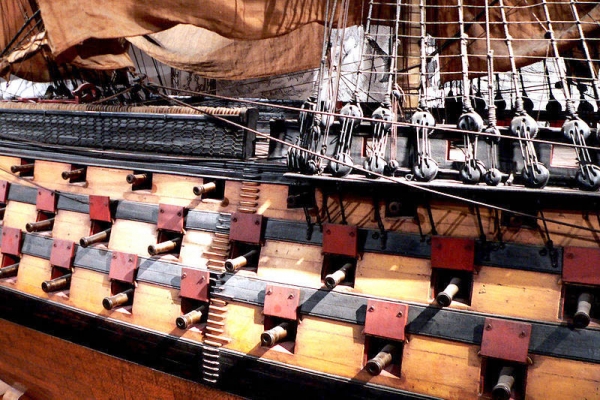
A "gun" was a cannon, mounted inside the boat. (Different classes of guns -- some were bolted to the floor, others were on a "bungee" system of ropes -- and no they were not called bungees, but I can't remember what they were called. Suffice it to say, when the cannon fired, it recoiled and then bounced forward. The ropes were used to keep it from blowing out the back part of the ship.)

74 Guns were considered small ships. With 4 men to handle a gun, (more or less), powder monkeys (boys who ran down the line and gave each gun the powder for the cannon), and ball men ( on one website of nautical terms I found several euphemisms that have come down through the years about balls -- brass balls, busting balls, etc. ). So below decks during a battle, there were about 100 men slaving away trying to keep the cannons loaded and firing.

Above decks, there were sailors (men who climbed the ratlines to unfurl the sails 3 men per sail, 3 sails per mast, 3 masts per ship), midshipmen (who took care of the decks 6 per side) carpenters, sailmakers, coopers, officers, petty officers, junior officers, mates, master mates and a whole array of other men who had lesser jobs. The life was hard, disgusting, dirty, the food horrible, the pay (if you weren't an officer) negligible. Which was why impressment was so prevalent during the Napoleonic wars.

On a 74 gun, a typical complement was 220 men. (Notice the word complement has an e not an i. Two different words.) That's a lot of men on a boat. With the guns taking up most of the hold, you can just imagine what the sleeping quarters were like.

And this is just a 74 gun Ship of Line. Can you even imagine what a 90 gun was like? 350 men? I can't fathom it.

Do I really need to do all this research for a romantic novel? The true answer is yes and no. I could have just skipped to the parts I really needed. Who was whom on the vessel and what they said or did. Do I have to know the names of the parts of the ship? Do I have to know the difference between a yeoman and a first mate or a petty officer? Not really. Will it add anything to the story if I mention the binnacle was wrapped in brass? Kind of but no, not especially.

Then why do I take so much time to do all this unnecessary research? Especially as I'm not even placing Richard on a Ship of the Line. As there will only be one very small battle between a cutlass and a trabocolu. Because I need to know what I'm talking about. If I said the bosun was manning a gun, I would be oh so very wrong and someone, somewhere would call me on it. Will I actually use most of the research I've done? Probably not. However, what I do use will be accurate and that is important. To me doing all this research helps set the "tone" of the novel. If I can't get the right tone, those scenes will be worthless.

So ask me what my favorite part of the research will be?

Watching the Horatio Hornblower series with Ioan Gruffud and Master and Commander with Russell Crowe.

Swashbuckling, dashing, an oh-so-romantic Naval heroes. Now you know why I do my research.


Tell me -- Do you appreciate an author who does detailed research? Or would you rather just skip to the romantic parts?

Anne Gallagher (c) 2013

Wednesday, June 12, 2013

Historical Research -- The Ten Thousand

I had a reader recently ask me -- "Why are all your characters seemingly related to one another? Lady Olivia is cousin to almost everyone, and then there are so many others who are second cousins or once removed cousins. What's up with that?"

The "original" aristocracy (meaning way back in the Middle Ages) was made up of Dukes and Barons fighting for their feudal lord. I suppose if you wanted to remain King you placed your friends and relatives close to you. (It didn't always work, but you know how it goes. Keep your friends close, your enemies closer.)

(Duke is in line for the throne -- any male with a bloodline that can be traced.** A Baron was like a body guard for the King. He kept his people in line. Sort of a Middle Ages County Sheriff.)

By the 1600's, the nepotism thing really took off. Dukes, Earls, Marquesses, were mostly made up of family members to the King. If you didn't have a title, you married into one. When you died and had no heir, the King usurped the title and then gave it to someone else. Which is why every man worth his salt tried to have as many kids as he could, to try to keep the title in the family. (Back then people died from even the smallest cold. Not to mention plague, sword fights, wars, so your life was always hanging in the balance. The more kids, the better off you'd be.)

Fathers used their daughters to gain entry into top families. If you were an Earl, you wanted your daughter to marry a duke's son. If you were a Baron, you wanted her to marry an Earl. Sometimes it worked. Sometimes it didn't. The son had to marry no less than his station. A Duke's son would marry no less than a Marquess or an Earl's daughter. Forget about love, it was all about the title and wealth.

By the time we enter the Regency, the aristocracy was made up of all these people who were related in one way or another. More or less. Enter the Ten Thousand.

http://en.wikipedia.org/wiki/Ton_(le_bon_ton)

Now, some speculate that the 10K was made up of 10K families. Which I think is a little much. That's a lot of people. I'm assuming, the 10K meant that it was made up of 10,000 family MEMBERS. That, to me, is a lot closer to the mark.

I grew up in the small state of Rhode Island. My immediate family consisted of me and my two brothers. My extended family consisted of six aunts and uncles. My first cousins equal twenty-one. When they married and had kids, my second cousins equal thirty-six. My third cousins number somewhere around twenty-five. (Honestly, I lost count.) So suffice to say, at the family reunion, there are a lot of us. That's not even counting who they married and how those families are also invited to the family reunion. (Because in Rhode Island, the Six Rules of Separation apply. I once met a woman on a plane to Vegas who was related to me through marriage to a second cousin. It's really a very small world.)

So, in writing my series, some of them must be related. Especially if they're members of the arisocracy. I had to make a family tree. On a big poster board. That hangs right by my desk. And then I had to add another one. Lady Olivia was at the top of the first one, but as the series continues, I had to go back further, thus the second one. In order to make all the pieces fit for the last book, I had to make a tree for Olivia's husband Fitzhugh (which also gave me an idea for a new series...hmmm...more on that another time.)

So, that's the exceedingly basic idea of how the ten thousand came to be known as the ten thousand. I didn't get into the Letters Patent, and how that applies to becoming a member of the 10K. I'll save that for another post. It's very droll and complicated. (I touch on it a little bit in THE LADY'S MASQUERADE.)

**Nowadays, women are also in line. Well they were also in line back then (Mary, Queen of Scots, Elizabeth, Victoria), but only if they were daughter to the King with no brother.

Tell me -- How many people are in your family?

Anne Gallagher (c) 2013

Wednesday, May 29, 2013

Historical Research -- Historical Characters

As a writer of historical fiction, I've done more research during the last four years than I ever did in high school or college, that's for sure. Between the food and clothing, not to mention horses, wagons, weapons, titles and precedence, there is just so much to learn .

When we "build" our historical world, most of it is right there in the history books so we only have to take what we need from that. Sometimes we find things -- like the fact that Claridge's was not actually a hotel in 1811, but a bed and breakfast, and famous Gunter's where everyone goes for ices, did not exist -- and we need to change the facts to adapt them to our story. (In my own little historical world, my fictional Bainbridge Hotel is the place to be.)

Same goes for historical figures. Sure, I can read every little thing about the Prince Regent from the history books, and by all accounts he was not a very well-liked man. From his Peers to his subjects, Prinny was probably the most despised of the modern monarchs. He had lost the respect of his people early on by marrying a divorced Catholic woman, and then drinking and spending money like it was nobody's business. So naturally, every book written about Prince George would come to the same conclusion that he was just a randy drunken wastrel.

Of course, we weren't there, so we can't know first-hand who the Prince actually was. We can't know why he acted the way he did. But we can probably guess. He was spoiled. He was a Prince trained to take over the greatest Monarchy (at the time) in the world. He was brilliant, and had the best tutors, could speak several languages, and was raised to be a King.

Okay, so given all that, don't you think that you would have gone a little bonkers too after you graduated college? (Yes, I'm being semi-cheeky here.) But what else was there for the man? He had no friends (well, good friends he could count on), his brothers were creeps, he couldn't work, he couldn't join the army, he couldn't really do anything except be a royal spoiled brat. Well, I suppose he could have been a nice kind generous man, but he wasn't.

When I began writing his character I took all of the above into consideration and came up with my own theory of why he was the way he was. I explain a little bit of it in THE LADY'S FATE. And although I'm not a psychologist by any stretch of the imagination, I can see where Prince George became the man they all hated. He was given the world, but piece by piece, they took it away from him. Including his wife, (whom he loved dearly), and truthfully, I think that's what made George so mad. I think that's why he rebelled the way he did. I mean, really. Parliament made him divorce his wife. I think I would be a little ticked off too, and try to get back at those who did it to me.

I tried to show George's more "human" side when I wrote him. I like George. I can empathize with his feelings over his situation. So I tried to show that he wasn't really "all" bad. Just a little.

In the case of Dudley Ryder, Illora Ryder's father in ROMANCING LADY RYDER, I chose to take the whole family into the book. There are too many articles about the Ryder family on Wikipedia, but I read them all and then concocted my own "Ryder family". See, Richard Ryder had been married, and had fathered six or seven children, however, he married later, which gave me the perfect opportunity to "invent" him a first wife, with Illora as the result. My first Lady Ryder was no longer with us, and Richard, had indeed married a woman named Susan, so I could fit another piece in to my "world-building puzzle".

In the case of the Ryder family, most of them were politicians, so I could use that in my plot line. I realized I was walking a very tight rope with this story, it is hardly plausible for the era. No self-respecting uncle would allow a girl to go traipsing about with an English gentleman, unescorted; never mind, play at spy. BUT, it's my story and it was fun to write.

The same with the Russian aspect of that same story. I took great liberties with Ambassador Novolsiltstov. Yes, he was the Czar Alexander's right-hand-man, but whether he lived in England for any length of time, I do not know. However, what you should know is that the Czar did move certain paintings and historical artifacts out of Russia in fear Napoleon would take them. It's these little details I find in doing research that can add so much to a story. So that's why they're there.

Naturally, in writing historical fiction, we do not need to have any historical figures in our books if we so choose. In building our "worlds" we can do whatever we want. However, I think it behooves us to have at least one or two somewhere in there. They add a little flavor, whether from our imagination or not, and ground us into the time frame.

What do you think?

Anne Gallagher (c) 2013


Wednesday, May 22, 2013

HIstorical Research -- Contractions

The last book of Regency romance I read was authored by one of the best-selling New York published writers in the world. Her romances are legendary, she's created dozens of characters, two or three series, and has hit the #1 spot more times than I care to count.

I hated that book.

The plot was flimsy, the main character was only interested in getting her man into bed, and the sex was...well, let's just say I skipped over that part. (If you've read one sex scene, you've read them all.) But the one thing that peeved me off to no end was that the author used contractions in her dialogue.

Can't Wasn't Don't Didn't Doesn't Shouldn't Wouldn't I'd We'd I'll You'll etc etc

Were not in much use by the aristocracy until the late 1830's. It seems they thought "proper" English kept them apart from the lower classes. And even though my etymological dictionary said that most of these words were being used from the 18th century, you will find, only the "lower classes" used "cant", or contractions.

Surprisingly, in digging into this research, the use of contractions originally started with publishers, newspaper men, and printing press operators. In order to fit so many words to a line, so many lines to a page, they decided to form contractions of these particular certain words. (There is a website to back me up on this, but I've lost it. It has a really funny name like WordSplunk dot com or something like that. If I ever find it again, I'll put it on my sidebar.)

Now some readers think that my non-use of contractions makes the story stilted and hard to read. And I say to them -- If you want a hard read, try Jane Austen. No contractions there. However, if you're going to write about 1811, you need to speak like you're in 1811 if you have dialogue in your book. No two ways around it.

There is one caveat to that statement however. None of us were living in 1811 so we can't really know how they actually spoke. All we have are letters and writings of the time. And if that is any indication of the language then, for me, there are no contractions in my stories. (Or very very few. I have been known to use You'll and I've on occasion.)

So, any word nerds out there? Do you think historical dialogue should be with or without contractions?

Anne Gallagher (c) 2013

Wednesday, May 8, 2013

Historical Research -- Reading Books

Now I've read probably thousands of historical romance books, but I don't consider that as research. Reading books for research consists of stuffy literary histories, maybe a few biographies, letters, authors of the time (Jane Austen, the Brontes etc.)

However, all this actually does is give me a headache. Flipping back and forth through a 500 page volume trying to take notes is not what it's all about. I need the facts, I need them now, and I need my research to be easy to comprehend. Sometimes, you can find everything you need to know on the internet, but that isn't really research -- Okay it is, but I generally refer to that as "light" research.

To fully understand whatever it is, you need to immerse yourself in. What I've begun doing, what I've found most enlightening actually is the "childrens" section in the library. They have everything, and it's easy to read, and easily comprehendable. Biographies, battles, even some classics that have depth and meaning.

When I was doing research for THE CAPTAIN'S LADY, I needed all kinds of things -- ships, manifests, slavery, North Carolina, Boston, abolitionists, the underground railroad -- etc. etc. A LOT of stuff.

I started with the classics Uncle Tom's Cabin. Gone with the Wind. (Yes, this was set later than I would have liked, but I wanted to get the "feel" for how I wanted to portray the slaves and land-owners.)

But then I got stuck in the abolishonist movement. William Wilburforce was instrumental in England, but what about in the America's? Harriet Tubman, of course, Frederick Douglass, John Brown. And yes these people were all decades later than when my story takes place, but the plight of the slaves and those who helped them are timeless. So I took those books from the children's section and read those. Easy, light, factual, everything I wanted. I hate getting bogged down.

And then on to the other things I needed. How to sail a boat, what crops grow in North Carolina (besides tobacco), pirate ships in North Carolina, architecture...everything was there in the children's section.

Now some might say I'm taking the easy way out, and I'll be the first to admit it. But if you're writing three books a year, you need to have "easy" on one list or another. Why not make it research. After all, I'm not writing about "history", I'm writing about fictional characters who are in history. If I get the facts right, the characters won't have to worry about what they're doing there.

Anne Gallagher (c) 2013

Wednesday, May 1, 2013

Historical Research -- What I'm Doing Now

I've been sick the last few days and forgot to write up a post about historical research for today. However,
I'm better now and right smack dab in the middle of creating a new story. Something BIG, (which I really can't tell you about now) but it's not one of my forthcoming books. This is an entirely new creation for something else entirely.

So, to begin, I needed to create a brand new character. I needed a French aristocrat. Knowing next to nothing about the French aristocracy, I played with Google and Wikipedia. My two favorite web-sites.

First, I needed to know how the French addressed their nobles.
http://en.wikipedia.org/wiki/French_nobility

Then I needed to decide which title he would have. I decided on Marquis.

Then which province he would have held under his title. I wanted something near the ocean. So I went here and chose Aunis.
http://en.wikipedia.org/wiki/Provinces_of_France

I then realized I needed to know just what exactly they did in Aunis and found a wonderful little place known for farming and salt.
http://en.wikipedia.org/wiki/Aunis

Then it was on to the larger topic of the French Revolution because I needed a reason for my character to escape France.
http://en.wikipedia.org/wiki/French_Revolution

In reading up on this, I found a man, the Marquis de Condorcet
http://en.wikipedia.org/wiki/Marquis_de_Condorcet who would be perfect for me to base my character's life on. Learned, with all the right political leanings, he chose to leave France after the Revolution. I believe I hit the jackpot with him.

Mind you, all this flipping back and forth on the computer, not to mention reading all the articles (and getting sidetracked on whether I needed to actually know what the flag looked like -- Fun Fact: Aunis is under the duchy of Aquitaine) took me just under two hours. But now I have the backstory of one of my characters.

And believe it or not, this man in my story is dead and is only mentioned in a paragraph containing five sentences. He is not relevent to the story at all. However, if I did not do this research, the story would have no substance. I could have just written him any old way. But I didn't. I chose to give this man a life, a backstory, a history, if you will because that was what was needed.

In shaping my main character, Dianne, I need to have all the pertinent information, and this above mentioned man is her father. So it would behoove me to get it right. Or at least as right as I can get in fiction.

Now, onto Dianne's mother....

Anne Gallagher (c) 2013

Wednesday, April 24, 2013

Historical Research -- Researching History

Breaking down history is kind of like breaking down an orange. First you peel away the outside, then the pith, then each section, and then you take the veins from the section. (What can I say, I like my oranges naked.)

For me, I chose to write about the Regency period. As a purist of the genre, my time frame covers the years between 1811 - 1820. When Prince George became Regent until he ascended the throne. To further pinpoint my time frame, my stories are set from March 1810 thru June of 1811. A mere 27 months. And although I'm writing a series, I'm writing an over-lapping series, so instead of my stories following each other, they overlap. More or less.

When I began writing, I thought this meant I would only needed to delve into a tiny piece of history. It didn't quite work out that way. As with all history, no matter where we start from, we need to research what happened BEFORE, to bring us to that point in time.

To make things easier on myself, I disregarded everything I couldn't do justice to, and kept it simple. There were so many things happening in England at the time. The Abolitionist Movement, Locomotives, Union Busting, Corn Laws, Luddites. All that in itself is overwhelming. I decided if it warranted my attention, and could play a part in my novels, I would research each separately for a book. But then, with so much information, how much could I possibly put in each novel?

There is a phrase -- Keep it Simple, Stupid -- to which I adhere. Yes, I do countless hours of research, (In THE LADY'S FATE, I spent almost a week researching the Royal Gardens, who tended them, Queen Charlotte and her favorite flowers, who belonged to the Royal Household and their titles, just to find out if Violet's father could have been a viable character. In the end, he only made a brief appearance at the end of the book and uttered two lines.) However, that research was invaluable and although most of it does not appear in the book, it lent itself to a more comprehensive storyline.

In ROMANCING LADY RYDER I cannot tell you how I studied the Napoleonic wars. Deciding to concentrate on Czar Alexander and the Russians and that small part of history seemed easier than to continue to have Remy/Greenleigh keep going to France to find Duclerc.

Now, I can tell you that Alexander did send an emissary to England. Whether it was actually Novosiltsov or not, I didn't get that far. I took literary license with the facts to create my "history". But, Novosiltsov was indeed the Czar's right hand man, the turquoise livery the servants wore, the paintings by Shibanov, the drink Ockhotnichnya created by the Russian boyarin for the Royal House, and the dialogue was all true. (Well, you really can't translate the Russian alphabet so I used a translator to put it all into the English alphabet.)

In the end, I thought the story was pretty good because of all the added research I did. (And yes, I know some of you wish the story had been longer. Truthfully, so did I, but I was on a deadline and well, that's what I ended up with. Maybe someday I'll release a longer version.)

Right now, I have 16 separate "folders" I have created in my Favorites Tab with titles ranging from Historical, Regency, France, Napoleonic Wars, India, Parliament, etc. Within these folders are articles I have found on the web. In my Regency folder alone there are 96 different articles ranging in topics to include -- dress, carriages, maps, Prince George, Debrett's Peerage, Covet Garden, Bow Street, etc. etc. In my Napoleonic file you can find articles that include -- ships, cavalry, regiments, battles, maps, etc. etc. not to mention the extensive listings of Napoleon himself.

I also have files I haven't put into folders and they're just hanging out on my sidebar. Maybe someday I'll get around to doing that. And all this doesn't even include the books I have on my shelves -- Webster's Biographical and Geographical Dictionaries (c) 1948 and 1943 respectively, A History of Barns, Primer of Navigation, Herbs and Medicinal Flowers, Harrod's Book of Fine Wines, the Complete Works of William Shakespeare, to name just a handful.

In the old days, back before there were computers, there was the library where most of us did our research. I remember countless hours poring over ancient volumes of encyclopedias, handwriting notes on legal pads, index cards with footnotes, files of paper folders cluttering up a small corner of my room.

Was it worth it? Is it worth it to waste so much time on research that you may never use? Absolutely. I've found readers appreciate the little things we place in our novels that might not make a difference if taken out of context. I had an acquaintance recently say to me, "My great-uncle used to tell us stories about the Russian boyarin when I was a child. It was so nice to see them regarded in your book."

So yes, every little bit of research you do helps.

Anne Gallagher (c) 2013

Sunday, April 7, 2013

Historical Research -- Word Choices

One of the things I learned as an early writer, was to write the books I want to read. I've been reading historical romance since 1975, so I'm no stranger to the genre. Steamy bodice rippers, filled with damsels in distress and the men who rescued them.

From these books, I gained a better understanding of not only history, but the words that were used at that time. Some of these words are obsolete now, or have come to mean different things in this new millenium. I was recently brought to task by a reviewer who claimed that I was using words that didn't make sense. She said --

"It's as if she's trying to show off her vocabulary by using the "big words" but she doesn't know what they mean so it comes off as amateurish."

Uh, no. I do know what they mean. Every single one of those "big" words, and a couple of the small ones too.

I use an etymological dictionary, which shows me EXACTLY when the word was first used, which language it originally came from, when it became an "English" word, and how it was used back then.

For instance, this reviewer claimed in THE LADY'S FATE that I used the term "nanny" in the wrong context, that nanny was not a word back then, and I should have said "governess" or "nurse/nursemaid".

I beg to differ, but the word "nanny" is listed in my etymological dictionary as being in use from 1795, and as my book is set in 1810, I have 15 years for it to be commonplace in the language.

I had also used the word "obloquy" once, and one of my regular readers said it stopped her reading because she had to look the word up in her "reference" dictionary because her regular dictionary didn't have it. The word is considered obsolete. I bowed to her observation, but I didn't like it. Now that I'm in the process of re-editing this novel, I'm putting it back in.

When I was reading historical romance all those many years ago, and I would stumble across one of those words, it was almost like a treasure hunt for me to find out what the word meant, and then to use it in a sentence. People today have no patience for the big words. They want instant gratification an don't want to be plagued by having to use a dictionary.(Or click out of their document to click on the dictionary app. God forbid, if they have to actually find a dictionary BOOK.)

Which I think is very sad. I think reading should get harder as children grow up, not easier. I think books should have some "big" words to stumble over. I think every house should have a big fat dictionary somewhere in the living room or kitchen and I think the next time my daughter asks me, "Mom, what does this word mean?" I am going to tell her, "Look it up in the dictionary."


Anne Gallagher (c) 2013 

Sunday, January 13, 2013

Almost Ready

You'll be happy to hear, THE EARL'S ENGAGEMENT is almost ready for publication. I hit a snag after I sent it off to my critique partners. You see, I wrote this book in a frenzy because it was supposed to be finished by the end of September, but I moved over the summer and didn't have a chance to even start writing it until September. I had an outline, and the first few chapters written, but never enough time to keep going with it.

I actually finished it on Thanksgiving weekend, but then had to take off the last 14 chapters because it sounded so much like THE LADY'S MASQUERADE I couldn't let it go out into the world like that. Hence, from Thanksgiving to New Year's Eve, I wrote the last third of the book all over again.

So, I polished it up a bit, sent it to my critique partners, and began to clean the house. See, that's what I do -- I write like a madwoman and neglect my house. When the book is finished, then I clean like a madwoman.

Anyway, as I was cleaning, I realized chapter 29 wasn't going to work. Well, it could have, but it didn't sound right, so I decided to do a little research. Upon further investigation, I found something that would make more sense, so over the weekend, I changed a few things around and hopefully, when you read it, you'll love it as much as I do.

It'll be back from my last critique partner at the beginning of the week, and I'm hoping to only have to do minimal revisions. And then by next weekend, I'll be publishing. Yay!

Sunday, January 6, 2013

What the New Year Will Bring

I'm awaiting edits from my critique partners before THE EARL'S ENGAGEMENT is ready for publication. Not too long now. Another week or two.

I'm not one for making resolutions, but I do have some goals in mind for the new year.

The first one is to finish rewriting THE LADY'S MASQUERADE. I've changed so many things around in the published books, that MASQUERADE really doesn't make sense any more. Hence the rewrites. I'm hoping to get through with that during the next couple of months. I have to add in more of Lady Olivia's story and how this series all started so I can finish the series with all of the unanswered questions, answered at last. (I'm hoping you'll enjoy it all.)

The second thing I'm hoping to do is finish writing THE CAPTAIN'S LADY. That is the second book in the Reluctant Grooms series. I started it about 3 years ago, and after learning all I could about the slave trade, I decided the book needs a major reconstruction. I love the story and Richard is one of my favorite heroes. I've based him on this character.

Richard has been a very quiet character. He does show up in some of my other novels, but for the most part, once he gets back from America, he and Amanda live a sedate country life. However, he does make an appearance in THE EARL'S ENGAGEMENT.

Third on the list is to work on an extensive outline for THE SEDUCTION OF MR. SUMMERVILLE. I've written books without outlines, allowing the characters to take me where they want to go, but found to my detriment, that is not always the best way to write. Then again, I have written outlines, and find I never use them. However, with SEDUCTION, there is a LOT of stuff going on and I have to make sure my research, characters, and timelines are in sinc. SEDUCTION will be the final book in the series and everything needs to be completely tied up in a bright bow. However, that book will not even be started until either late fall or the beginning of 2014. I have several other projects that need to be finished in my "other" genre (contemporary women's fiction).

As for short stories -- I'm not sure where I stand with those yet. I don't have any characters knocking around in my head wanting me to tell their story. But maybe I'll be inspired at some point. 

I also have to find time to reformat everything for sale in paperback and let me tell you how much time reformatting takes. Unfortunately, I can't spend every day writing, there is also the business aspect, and marketing and promotion takes time away from my keyboard.

So, those are my goals. I hope you come along for the ride. 

Sunday, May 13, 2012

Regency Research

I've always loved the Regency period in England, and growing up that was nearly all I ever read. I've found over the years, the same historical figures time and again, and that made it somewhat easier for me to do research into the genre. I felt I knew them already. From the Prince Regent to Lady Crowper.

In this modern day and age, you're only one click away from whatever it is you may be looking for. But that does have its drawbacks. Yes, you can get an overview of the Napoleonic Wars, or what Prince George did in his first four months of the Regency, but those are generally bare bones factoids.

As a connoisseur of all things Jane Austen, I've found her books to be fonts of knowledge. The Bronte sisters, and Lord Byron as well. Some modern day authors have set about to recreate the era, Georgette Heyer for one, and there is also a smaller more select group that has taken on Jane Austen's lesser characters and created books for them in the same kind of style -- my favorites Julia Barrett (Margaret Dashwood) and Joan Aiken (Jane Fairfax). There is also C.S. Forrester who wrote the Horatio Hornblower series, but those titles talk of ships and the war, which is not a bad thing, however, not necessarily light reading.

Not only do I read, I also watch movies. There are some great films which deal with the era, (Sense & Sensibility, Pride & Prejudice, Persuasion, This Charming Man, Vanity Fair, Master & Commander, Becoming Jane, The Duchess) However, I've found that although these films have fabulous costumes and unbelievable cinematography, they do not all use dialogue from the era, which to me, lessens the film considerably.

I, for one, am a stickler for dialogue. Certain contractions were not in use in the early part of the 19th century, hence, cannot, do not, would not. I have an etomylogical dictionary for that purpose and I try and stay as close to the word choices of the day that I can.

Some writers also go so far as to include reams of description of food and clothing, which is nice, but I don't necessarily do that. On occasion I will mention a nice kidney pie, or a glass of port, but I know how I feel when I read something that contains four paragraphs of what was on the dinner table. To me, that just takes away from the reading of the book. And I don't necessarily care that the morning gown the heroine wore was made of yards of imported silk, capped with an organza overlay with enbroidered flowers around the hem and neckline. I'd rather just know the color. But that's just me.

Readers have their quirks, and some don't mind the endless reams of description. However, as a character driven writer, I'd rather spend time developing the interiority and emotion responses of the characters than delving into a blow by blow of the architecture of the house on Grosvenor Square.

Now that's not to say I don't research all this. I have a set of instructions in how to load and fire a flintlock, as well as a manual on surgeon's tools and what each do. I have (at last count) 187 pages in folders dedicated to the Regency era, Ranging from How to Address a Peer, to a Map of England (with street names and buildings) from 1813, to even a page concerning the weather events in England during that time.

Yes, research is important, there is nothing worse for a dedicated reader of the Regency to find a mistake, which is why I take the time to do the research in the first place, however I don't necessarily use it.

Tell me -- Do you feel cheated if the author hasn't done enough research? Can you tell the difference between an author who does, and one who doesn't?